SDR panadapter with antenna switch/splitter
published:
The following post describes how I have set up my HAM transceiver with an SDR panadapter, using an external antenna switch (signal splitter), with automatic syncing between SDR software and radio.
Two options for making an SDR panadapter for a HAM radio
- Hooking directly to the IF of the radio:
- Bandpass front-end filtering "for free" (thus even a cheap SDR like rtl-sdr could be used)
- TX protection for free (the tap is inside the receive chain of the radio)
- Invasive
- You need to modify each radio you want to use with a panadapter
- Using an external antenna switch:
- Non-invasive
- Can be used with multiple radios
- You need slightly better SDR hardware as the SDR is connected directly to the antenna (via antenna switch) — I used the Airspy HF+ Discovery and it does a great job
- You need a decent antenna signal splitter that will quickly and properly disconnect the SDR (connect it to a dummy load) when you TX — I used the excellent RX Audite SDR Switch
- Using an antenna switch you get at least 3 dB of signal loss as the signal is split in half, but on HF that is not a problem at all (assuming you have a decent SDR) — even the 6m band is fine in my testing (Note: for 6m I use Airspy R2)
SDR panadapter with antenna splitter/TX switch
- HAM Radio Deluxe (HRD) controlling the radio via CAT (note: HRD runs perfectly fine on Linux via Wine!) (I know it is bloated and many dislike it, but I like and use HRD solely as a graphical user interface, i.e. to control my radio via GUI from a computer)
- Flrig synced to HRD via a virtual serial port pair (use VSPE on Windows or socat on Linux1) via HRD Tools/Hardware/3rd-Party Serial Port
- SDR software SDR++ synced to the radio using its built-in Rigctl server (an implementation of the hamlib rigctld protocol).
- SDR++ is then synced to Flrig via the cat-relay Python program (use Logger_Mode: flrig), and thus to HRD and to the radio.
- I can tune anywhere — on the radio, in HRD, Flrig, or by clicking a frequency on the SDR++ panorama — and the radio will sync instantly
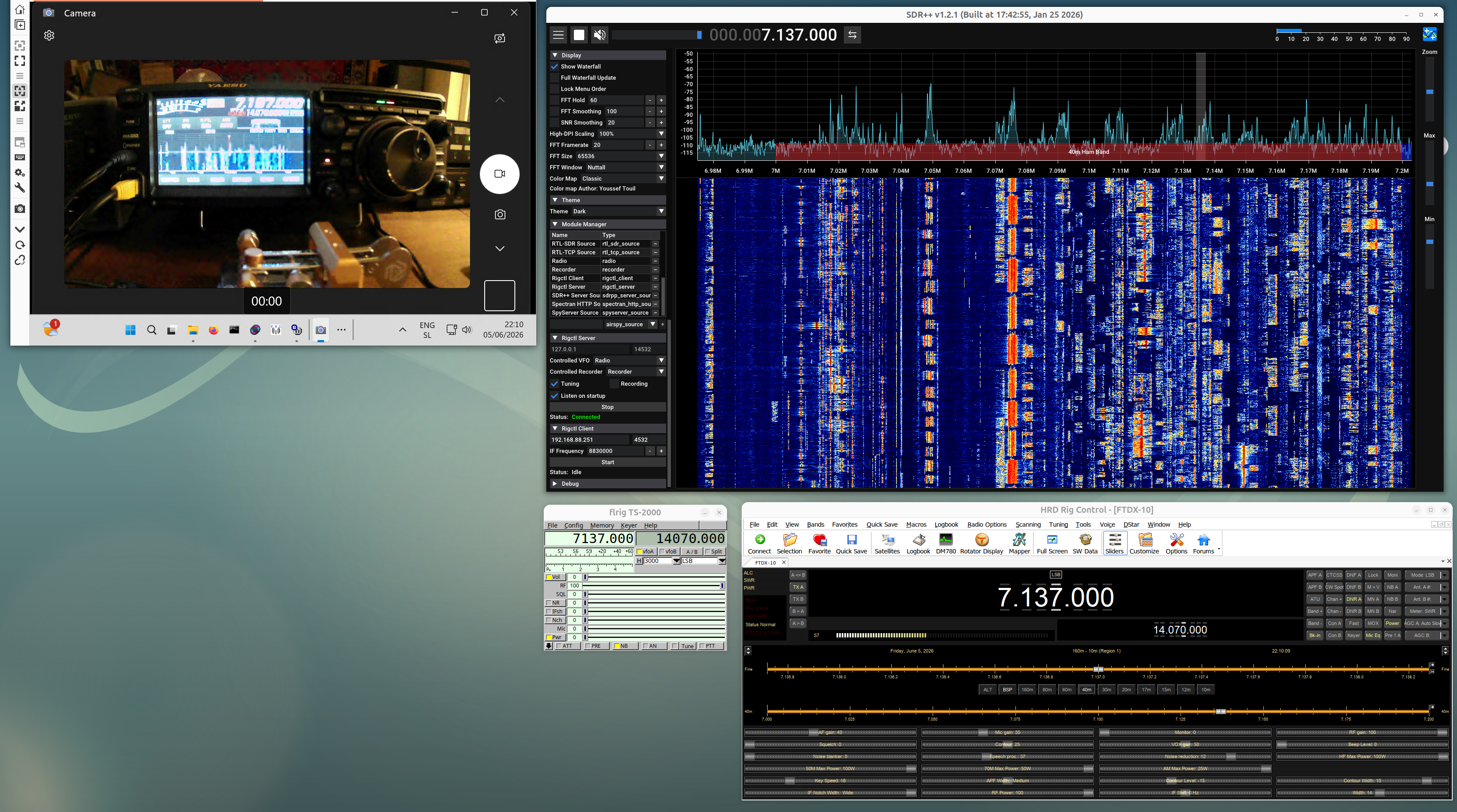
The image shows SDR++ synced to my radio FTDX-10 (streamed on camera, remotely), and HRD/Flrig.
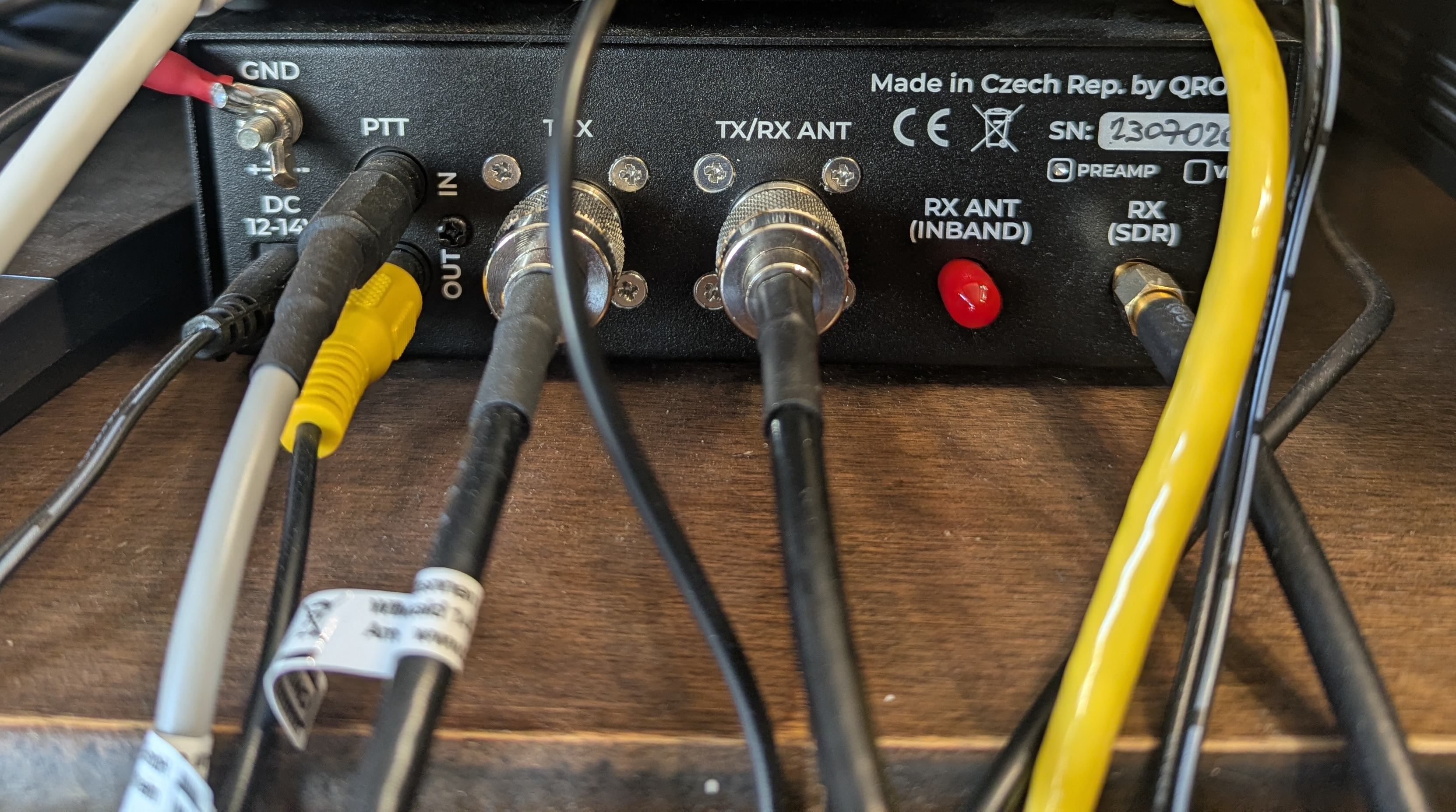
RX Audite SDR Switch/splitter:
- TX/RX Antenna port: connected to antenna
- TRX port: connected to transceiver
- RX(SDR): port connected to SDR
- PTT IN: PTT signal from transceiver: When TX on radio, SDR is disconnected (connect to a dummy load)
1
Example: Create a virtual serial port pair on Linux with socat:
socat pty,raw,echo=0,link=$HOME/dev/virtualcom2 pty,raw,echo=0,link=$HOME/dev/virtualcom3All of that (and more!) can be done by operating remotely (transceiver connected on a remote machine) -- see Remote HAM operation